COVENTRY UK
COVENTRY
HomeInvestigationEnsayo SPT (Standard Penetration Test)

SPT (Standard Penetration Test) in Coventry

Evidence-based design. Reliable delivery.

LEARN MORE

A seven-storey student accommodation block near Coventry University's city centre campus required foundation design in ground underlain by the Kenilworth Sandstone Formation. The geotechnical team selected SPT as the primary investigation method because it delivers a direct measure of refusal in the weak sandstone bands that alternate with glacial till across the city. Each test recorded blow counts every metre, and the N-values were correlated against local published data from the British Geological Survey sheet for Coventry. Before finalising the foundation layout, the team also ran a parallel clasificación de suelos on disturbed samples to confirm the Unified Soil Classification of the till horizons. The SPT results drove the pile design parameters and confirmed that the sandstone bands could support a working load of 350 kN per pile without excessive settlement.
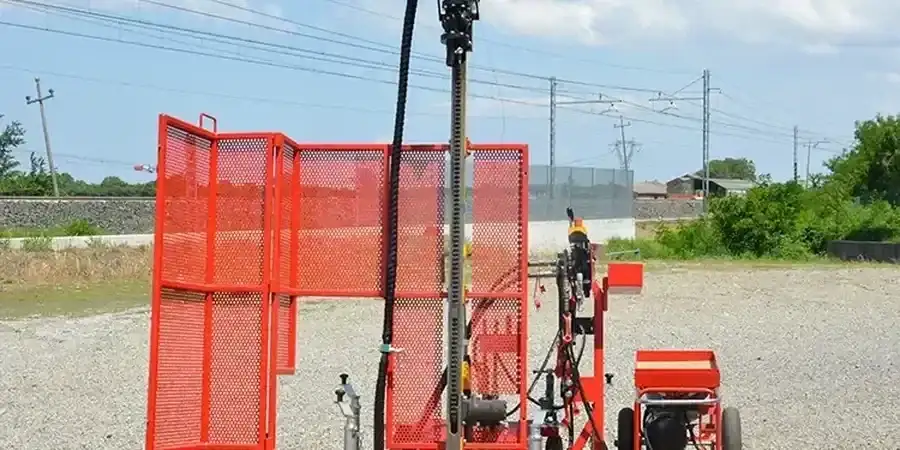
Illustrative image of SPT (Standard Penetration Test) in Coventry
SPT in Coventry's till-sandstone sequence provides the most reliable N-value profile for foundation design in the Mercia Mudstone Group.
Our service areas

Process overview

BS EN 1997-2:2007 and BS 5930:2015 define the execution and reporting of SPT in the UK. In Coventry, where the superficial geology includes the Oadby Member till overlying the Mercia Mudstone Group, the test provides a continuous profile of relative density and consistency. The procedure follows a standard 63.5 kg hammer dropped 760 mm, recording blows for three successive 150 mm increments. The top 150 mm is considered seating drive and is discarded; the sum of the next two increments gives the N-value. For deeper strata, the test is run at 1.0 to 1.5 m intervals, with continuous sampling using a U100 tube in cohesive horizons. The results feed directly into bearing capacity calculations using the Terzaghi and Meyerhof methods. Complementing the SPT survey with capacidad de carga analysis allows the design team to correlate N-values with allowable net pressures for shallow foundations in the till. When the underlying sandstone is encountered, the SPT refusal criterion (typically 50 blows per 75 mm) signals rockhead depth with high confidence, and the data can be cross-checked against a tomografía sísmica survey to map lateral variability in the weathered zone.
Technical reference — Coventry

Local context

Ground conditions across Coventry vary significantly between the southern suburbs, where the till is dense and overconsolidated, and the northern industrial areas near the River Sowe, where soft alluvial clays and peat lenses occur. The risk of underestimating settlement in those soft zones is real: an SPT in a peat lens can return N-values below 4, misleading a designer into specifying deep foundations unnecessarily. A proper SPT programme spaced at 10 to 15 m centres and extended to refusal or 5 m below foundation level catches those soft pockets. Without it, differential settlement between adjacent pads could exceed 25 mm, violating the serviceability limit state under Eurocode 7.

Need a geotechnical assessment?

Reply within 24h.

Email: contact@geotechnical-engineering.biz

Visual overview


Reference standards

BS EN 1997-2:2007 (Eurocode 7 Part 2: Ground Investigation and Testing), BS 5930:2015 (Code of Practice for Ground Investigations), BS EN ISO 22476-3 (Standard Test Method for SPT and Split-Barrel Sampling)

Technical parameters


ParameterTypical value
Hammer mass / drop height63.5 kg / 760 mm
Sampler dimensions (internal / external diameter)35 mm / 51 mm
Blow count recording incrementThree 150 mm drives; N = blows for drives 2 + 3
Refusal criterion50 blows for any 75 mm increment or 100 blows total
Correlation for relative density in sandN < 4: very loose; 4–10: loose; 10–30: medium; 30–50: dense; >50: very dense
Correlation for consistency in clayN < 2: very soft; 2–4: soft; 4–8: firm; 8–15: stiff; 15–30: very stiff; >30: hard

Top questions

What is the typical cost of an SPT in Coventry?

A standard SPT with split-spoon sampling at 1.0 m intervals in a single borehole typically costs between £390 and £670 in Coventry, depending on depth, access conditions, and whether energy measurement is required. The price includes field supervision, sample handling, and a certified report.

How deep should SPT boreholes go in Coventry's ground conditions?

Boreholes should extend to at least 5 m below the proposed foundation level or until SPT refusal in the sandstone bands. In the southern areas where the till is dense, 10 to 12 m boreholes are common. Near the river, deeper penetration may be needed to pass through soft alluvium into competent strata.

What N-value indicates rockhead in the Mercia Mudstone Group?

In the Mercia Mudstone Group beneath Coventry, an N-value exceeding 50 blows per 75 mm (refusal) is the accepted indicator of rockhead. However, a weathered zone with N-values of 30 to 50 can extend 1 to 2 m above intact rock, so the test should continue past the first refusal to confirm the transition.

Location and service area

We serve projects across Coventry.

Location and service area