COVENTRY UK
COVENTRY
HomeGeophysicsTomografía sísmica de refracción/reflexión

Seismic Tomography for Coventry Ground Investigations

Evidence-based design. Reliable delivery.

LEARN MORE

In Coventry, many site investigations hit an unexpected hard band of Mercia Mudstone or superficial glacial till that masks deeper bedrock, making standard borehole logs unreliable for foundation design. Seismic tomography resolves this by generating a 2D or 3D velocity model of the subsurface, distinguishing between weathered rock, stiff clay, and massive sandstone. Before committing to deep foundations or basement excavation, the team cross-references these velocity profiles with ground-truth data from an ensayo SPT to calibrate stiffness parameters. The method works particularly well across the city's variable drift deposits, where lateral changes in seismic velocity can indicate buried channels or solution features inherited from the Carboniferous limestone underneath. For a typical 15-storey residential block near the ring road, the survey covers a 200-metre line with 48 geophones spaced at 2 metres, producing a ray-path density that resolves anomalies down to 2-metre diameter.
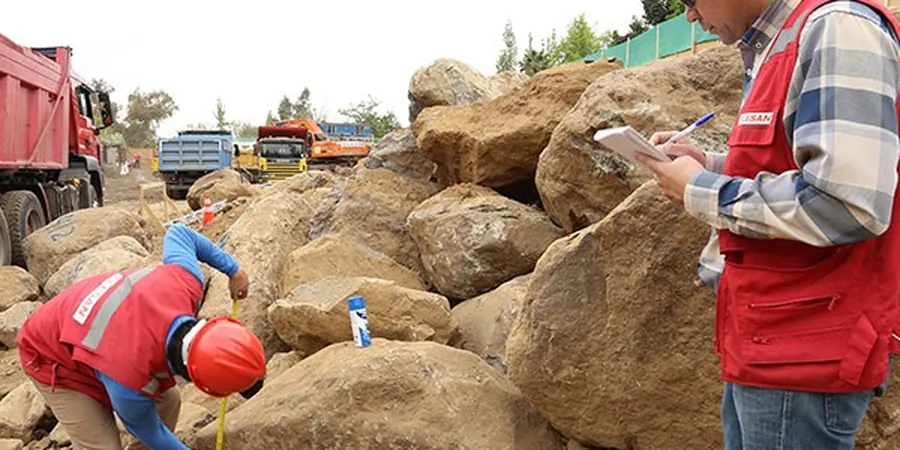
Illustrative image of Seismic tomography (refraction/reflection) in Coventry
Seismic tomography in Coventry delivers continuous velocity profiles that expose buried channels and rockhead variations, reducing borehole requirements by up to 40 percent.
Our service areas

Process overview

A typical deployment for a Coventry office park involves a 24-channel array with a sledgehammer source for the first 15 metres and a mini-vibroseis for deeper penetration to 40 metres. The survey crew lays out a 180-metre spread along the proposed building footprint, recording P-wave and S-wave arrivals to build separate velocity fields.
  • Refraction tomography resolves the top-of-rock profile, critical for piled foundations in the city centre where the Mercia Mudstone dips below 12 metres.
  • Reflection processing highlights stratigraphic boundaries and fault offsets down to 80 metres, useful for tunnel alignments under the Coventry Canal.
  • MASW analysis from the same dataset yields VS30 values for seismic site classification per Eurocode 8.
The field work takes two shifts, and the inversion models are delivered within five working days, with a full technical report that includes ray-path coverage maps and velocity contours. This combination of refraction and reflection methods reduces the need for multiple boreholes and provides continuous coverage between intrusive points, which is especially valuable on brownfield sites where former mine workings may be present.
Technical reference — Coventry

Local context

Coventry's underlying geology includes the Arden Sandstone and the Kenilworth Sandstone Formation, both prone to dissolution cavities where groundwater flow has created voids up to 3 metres in diameter. A seismic tomography survey detects these cavities as low-velocity zones with high attenuation, allowing the design team to plan grouting or deep foundation solutions before construction starts. The city also sits within a moderate seismicity zone (peak ground acceleration 0.08 g for a 475-year return period), so the measured VS30 values from the shear-wave component directly inform the ground type per BS EN 1998-1:2004. Ignoring these velocity anomalies risks differential settlement or punch-through failure in overlying cohesive soils, particularly on sites along the River Sowe floodplain where superficial deposits thicken rapidly.

Need a geotechnical assessment?

Reply within 24h.

Email: contact@geotechnical-engineering.biz

Reference standards


BS 5930:2015 Code of practice for ground investigations, Eurocode 7 (EN 1997-1:2004) Geotechnical design, BS EN 1998-1:2004 Seismic design of structures (site classification), BS 1377 Standard guide for seismic refraction

Technical parameters

ParameterTypical value
Array length180 – 250 m
Number of geophones24 – 48
Source typeSledgehammer (4.5 kg) / Mini-vibroseis
Depth of investigation15 – 40 m (refraction), up to 80 m (reflection)
Resolution2 m lateral, 1 m vertical in upper 15 m
Deliverable format2D velocity model (DXF, SEG-Y) + geotechnical report
Turnaround time5 working days (field + office)

Top questions


How deep can seismic tomography reach in Coventry's ground conditions?

Refraction tomography typically resolves velocities down to 40 metres when using a mini-vibroseis source, while reflection processing can image deeper structures up to 80 metres. The actual depth depends on the energy coupled into the ground and the velocity contrast at the target horizon. In Coventry, the Mercia Mudstone and Arden Sandstone produce strong refracted arrivals that allow reliable picks to 35 metres with a standard sledgehammer array.

What is the cost range for a seismic tomography survey in Coventry?

A typical survey with 24 geophones, one line of 180 metres, and full refraction + MASW processing costs between 2,390 and 3,960 GBP. The price varies with site access, the number of shot points, and whether reflection processing is required. A fixed-price quotation is provided after a site walkover to confirm line layout and source type.

How does seismic tomography compare to boreholes for cavity detection?

Boreholes give a single point of information and can easily miss a cavity located between them. Seismic tomography produces a continuous 2D velocity cross-section, so a low-velocity anomaly typical of a void (velocity drop of 30–50%) is clearly visible. The method is non-intrusive and covers large areas faster than drilling multiple holes, though a few verification boreholes are still recommended to calibrate the velocity model with actual soil or rock samples.

Location and service area

We serve projects across Coventry.

Location and service area