COVENTRY UK
COVENTRY
HomeIn-SituVeleta de campo (Vane Shear Test)

Field Vane Shear Test (VST) in Coventry – Undrained Shear Strength for Soft Soils

Evidence-based design. Reliable delivery.

LEARN MORE

BS 1377-7:1990 is the governing standard for the field vane shear test (VST) in the UK, and it is especially relevant in Coventry because the city sits on a mix of glacial till and alluvial clays over Mercia Mudstone. These soft to firm cohesive soils can hide low undrained shear strength that standard penetration tests cannot capture. We deploy a Geonor H-10 vane with a 65 mm blade to measure peak and remoulded torque directly at depths up to 20 m. For projects requiring continuous strength profiling before design, we often combine VST with a tomografía sísmica to cross‑check stiffness profiles without drilling additional holes. In Coventry, where historic mining and variable groundwater affect consistency, the vane test gives the quickest reliable Su value for embankments, excavations, and shallow foundations.
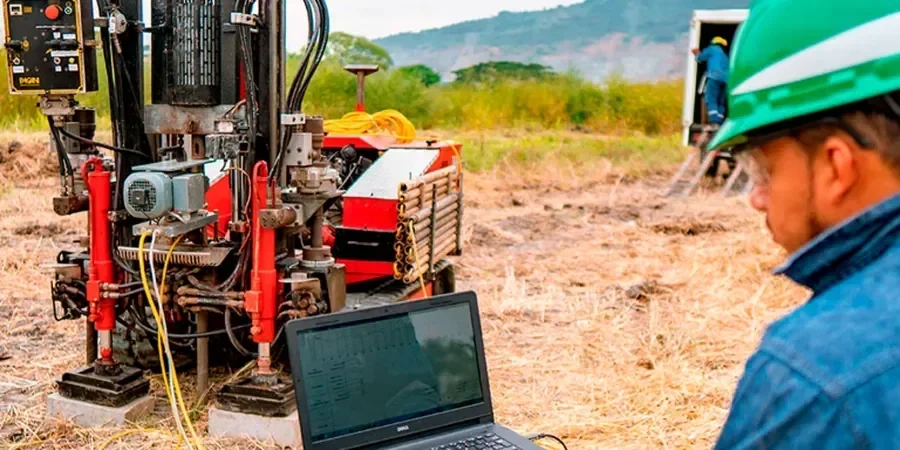
Illustrative image of Field vane shear test (VST) in Coventry
A vane test in wet clay can cut investigation time by half compared to sampling and triaxial, while delivering Su with ±5 kPa repeatability.
Our service areas

This service complements our laboratory testing work for a complete project analysis.

Process overview

Coventry’s seasonal rainfall averages 620 mm per year, but the underlying clay can stay saturated for weeks after a wet spell. That moisture reduces effective stress and makes the vane correction for plasticity index critical. We apply the Bjerrum correction factor (μ) based on PI ranges from 15 to 60, which can lower the uncorrected Su by 20 to 40 percent. Our procedure follows BS 1377-7:1990 exactly: vane insertion at 15 mm/s, rotation at 6° per minute, torque recorded every 15 seconds. We also perform the remoulded test after 10 full rotations to obtain sensitivity. For deep excavations in Coventry’s alluvial terraces, the field vane shear test (VST) data feeds directly into the estabilidad-taludes analysis for temporary works. All equipment is calibrated annually to UKAS schedule, and the results are traceable to NPL standards.
Technical reference — Coventry

Local context

A six‑storey student accommodation block near Coventry University’s Priory Street was designed with a net bearing pressure of 120 kPa based solely on SPT N‑values. The contractor noticed excessive settlement after the first lift of blockwork. We ran four field vane shear tests (VST) at 3 m intervals and found the actual undrained shear strength was only 55 kPa — half the assumed value. The design had to be re‑worked with a raft foundation and 1.5 m of granular replacement. A vane test during the desk study phase would have cost less than one day’s delay. In Coventry, the combination of soft alluvial clay and variable groundwater makes VST essential for any structure over 50 kN/m² bearing pressure. Ignoring Su can lead to differential settlements that crack brickwork and strain services.

Need a geotechnical assessment?

Reply within 24h.

Email: contact@geotechnical-engineering.biz

Reference standards


BS 1377-7:1990 – Methods of test for soils: shear strength (vane test), Eurocode 7 – EN 1997-2:2007, Section 6 – field vane tests, BS 1377-9 – Standard test method for field vane shear test in cohesive soil

Technical parameters

ParameterTypical value
Vane typeGeonor H-10, 65 × 130 mm rectangular blade
Max depth20 m (standard rods); extension rods available
Torque range0 – 200 N·m, resolution 0.1 N·m
Rotation rate6° ± 1° per minute (BS 1377-7)
Bjerrum correctionμ = 0.8 – 1.0, based on PI per Ladd 1977
Sensitivity range1.0 (insensitive) to >8 (quick clay)
Output parametersSu peak, Su remoulded, sensitivity, corrected Su

Top questions


What is the difference between a field vane shear test and a laboratory triaxial test for Su?

A field vane tests the soil in its natural state without disturbance from sampling, transport, or extrusion. It gives the undrained shear strength directly at the test depth. A triaxial test requires an undisturbed sample, which can lose structure and moisture during handling. In soft clays common in Coventry, VST typically yields 10–20 % higher Su than triaxial due to less disturbance. The vane is also faster — one test hole per day versus weeks for sampling and lab work.

How does the Bjerrum correction affect VST results in Coventry clay?

The Bjerrum correction factor (μ) accounts for the effect of plasticity index on the vane failure mode. In Coventry’s alluvial clays, the PI ranges from 20 to 50, so μ varies between 0.85 and 0.95. That means the uncorrected Su is reduced by 5 to 15 percent. We always report both the uncorrected and corrected values so the geotechnical designer can apply their own factor if needed.

Can VST be performed in gravelly or sandy soils?

No, the vane test is only suitable for cohesive soils — clays, silty clays, and peats — where the soil can shear along a cylindrical surface without drainage. In gravels or sands, the vane would rotate without mobilising a consistent failure plane, and the torque reading would be unreliable. For non‑cohesive soils in Coventry, we recommend the standard penetration test or a cone penetration test instead.

How much does a field vane shear test cost in Coventry?

A typical VST investigation in Coventry costs between £570 and £1,040, depending on the number of test depths, access conditions, and whether a site visit is required. This includes mobilisation, on‑site testing, Bjerrum correction, and a certified report within 48 hours. For multiple test holes or repeat visits, the per‑test cost decreases.

Location and service area

We serve projects across Coventry.

Location and service area