COVENTRY UK
COVENTRY
HomeSlopes & WallsRetaining Wall Design in Coventry | Geotechnical Expertise

Retaining Wall Design in Coventry | Geotechnical Expertise for Stable Ground

Evidence-based design. Reliable delivery.

LEARN MORE

The difference between Coventry's city centre and its suburban fringes, like Earlsdon or Stoke Heath, often comes down to soil variability. Near the city core, we typically encounter a mix of made ground and firm clays from the Mercia Mudstone Group, while the outskirts feature denser glacial till and sand lenses. For any retaining wall design in Coventry, our team must first determine whether the excavation will face soft clay prone to squeezing or stiffer deposits with better natural drainage. That preliminary classification directly affects the wall type — a simple gravity structure may suffice in one spot, while a reinforced cantilever wall becomes necessary just a quarter mile away. Before we start calculations, we always run a plate load test on site to confirm the modulus of subgrade reaction, ensuring the design matches real ground behavior.
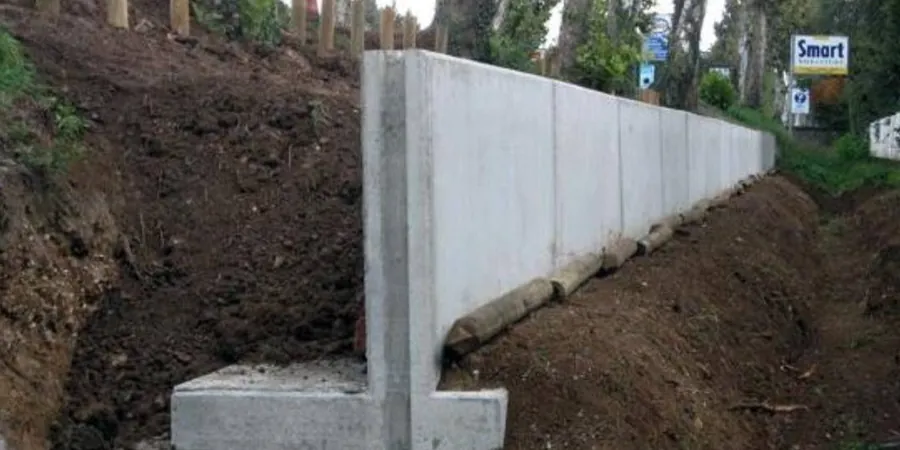
Illustrative image of Retaining wall design in Coventry
Even a modest rise in pore pressure behind a retaining wall can double the lateral load on the structure.

Our service areas

Process overview

Coventry's climate, with roughly 650 mm of annual rainfall and a perched water table that fluctuates between 1.5 m and 4 m depending on the season, demands a careful approach to drainage behind any retaining structure. Our retaining wall design in Coventry always incorporates a gravel drainage blanket and a perforated pipe at the base, because even a modest rise in pore pressure can double the lateral load on the wall. When the subsoil includes thin layers of silt, we also check for internal erosion using a field permeability test to size the filter properly. The following parameters are typical for a reinforced concrete cantilever wall in this region:
Technical reference — Coventry

Local context

The Mercia Mudstone that underlies much of Coventry is prone to softening when exposed to water. If a retaining wall excavation remains open during wet weather, the base can degrade rapidly, reducing bearing capacity by up to 40% in a single day. That is why we insist on a concrete blinding layer poured within hours of reaching formation level. Another risk comes from buried obstructions — old foundations, former coal workings, or undocumented services — that can block the wall alignment or alter groundwater flow. Our retaining wall design in Coventry always includes a trial pit or borehole survey along the wall footprint to identify these hazards before any concrete is ordered.

Need a geotechnical assessment?

Reply within 24h.

Email: contact@geotechnical-engineering.biz

Reference standards


Eurocode 7 (BS EN 1997-1:2004) – Geotechnical design, BS 5930:2015 – Code of practice for ground investigations, AASHTO LRFD Bridge Design Specifications – Section 11 (Retaining Walls), CIRIA C580 – Embedded retaining walls (UK guidance)

Technical parameters

ParameterTypical value
Design codeEurocode 7 (BS EN 1997-1:2004) + UK National Annex
Typical wall height2.0 m to 5.5 m
Soil type (backfill)Granular Class 6N or 6P per SHW
Minimum safety factor (overturning)2.0
Drainage pipe diameter100 mm perforated, wrapped in geotextile
Coefficient of friction (concrete/clay)0.30 to 0.45

Top questions


What is the typical cost range for retaining wall design in Coventry?

For a standard 3 m high cantilever retaining wall on a residential site in Coventry, the design fee typically falls between £850 and £3,620, depending on the number of revisions, groundwater complexity, and whether a full ground investigation report is required.

Do I need planning permission for a retaining wall in Coventry?

If the wall exceeds 1.0 m in height or is located near a boundary, planning permission is usually required. Coventry City Council also expects a geotechnical design note confirming stability and drainage. We can prepare that note as part of our retaining wall design in Coventry.

What soil conditions affect retaining wall design in Coventry?

The dominant soil is Mercia Mudstone, a firm to stiff clay that can soften quickly when wet. Glacial till with sand and gravel lenses also appears in northern suburbs. Both can cause differential settlement if not accounted for in the wall foundation design.

How long does a retaining wall design take?

A preliminary design with stability calculations typically takes 5 to 10 working days once the ground investigation data is available. Detailed construction drawings and specification add another week, depending on wall complexity.

Location and service area

We serve projects across Coventry.

Location and service area