COVENTRY UK
COVENTRY
HomeSlopes & WallsSheet pile wall design

Sheet pile wall design in Coventry

Evidence-based design. Reliable delivery.

LEARN MORE

While the sandy terrace gravels along the River Sowe provide decent bearing for shallow foundations, the soft alluvial clays near the Coventry Canal demand a completely different approach. In the city centre, where basement excavations reach 5 m into these compressible deposits, a sheet pile wall design must account for both the hydrostatic pressure from the local water table and the limited lateral resistance of the clay. Before fixing the embedment depth, we always run a calicata exploratory pit to verify the stratigraphy at the precise location of the wall, because borehole spacing alone misses thin sand lenses that control drainage.
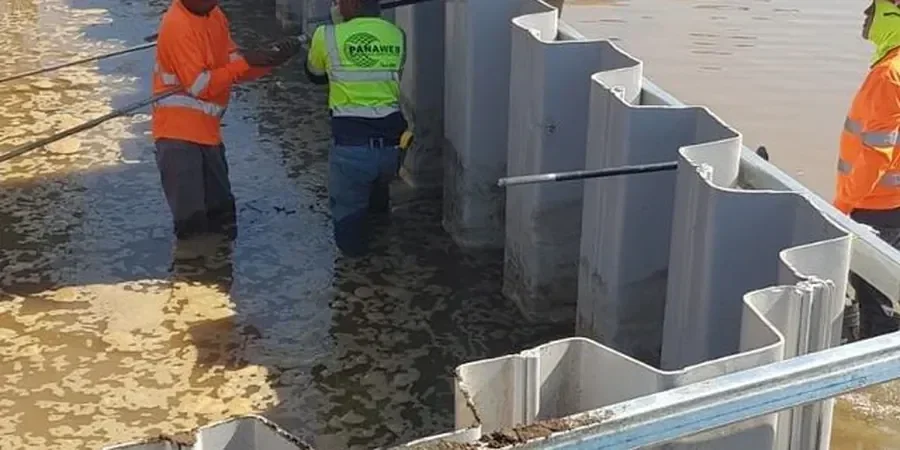
Illustrative image of Sheet pile wall design in Coventry
A proper sheet pile wall design in Coventry must integrate reliable soil strength parameters, water pressure profiles, and anchorage verification for walls exceeding 5 m.

Our service areas

Process overview

A mistake we see repeatedly in Coventry is assuming that a standard cantilever sheet pile wall will work for every 4 m excavation. On a recent commercial plot off the A444, the contractor specified a steel AZ section without considering the soft peat layer at 3.8 m depth, which reduced the passive resistance by nearly 40 %. A proper sheet pile wall design in Coventry must integrate the following:
  • Reliable soil strength parameters from triaxial tests on undisturbed samples
  • Water pressure profiles that reflect seasonal fluctuations — the Sherbourne Valley aquifer rises up to 1.5 m in winter
  • Anchorage verification when the wall height exceeds 5 m, using the tie-back capacity from nearby pull-out tests
We cross-check every parameter against the geological maps of the Warwickshire Coalfield to avoid surprises.
Technical reference — Coventry

Local context

A 14‑storey student accommodation block in the Earlsdon area of Coventry required a 7 m deep basement. The original sheet pile wall design assumed a drained condition, but after heavy November rains the water table rose 1.2 m above the design level. The unbalanced hydrostatic pressure caused a 60 mm lateral displacement of the wall, nearly damaging the adjacent Victorian sewer. We had to install a relief drainage system behind the wall and re‑anchor the top row at 30 kN/m higher load than planned. That incident taught us to always model the worst‑case groundwater scenario for Coventry’s clay‑filled basins.

Need a geotechnical assessment?

Reply within 24h.

Email: contact@geotechnical-engineering.biz

Reference standards


Eurocode 7 – EN 1997‑1:2004, BS 5930:2015 – Code of practice for ground investigations, CIRIA C760 – Guidance on embedded retaining walls, BS EN 10248 – Hot‑rolled sheet piles of non‑alloy steels

Technical parameters

ParameterTypical value
Wall height range3 m – 12 m
Typical steel section (AZ series)AZ 18 – AZ 48
Corrosion allowance (UK urban environments)2 mm – 4 mm
Maximum allowable deflection at serviceabilityH/200
Anchorage spacing (grouted tie-backs)1.8 m – 3.0 m c/c

Top questions


What is the typical cost range for a sheet pile wall design in Coventry?

The cost for a bespoke sheet pile wall design in Coventry typically ranges from £1.020 to £4.580, depending on the wall height, number of anchor levels, and the complexity of the ground conditions. This includes the numerical analysis, reinforcement detailing, and a design report with construction drawings.

How deep should the sheet piles be embedded in Coventry clay?

Embedment depth depends on the retained height and the undrained shear strength of the clay. For a typical 4 m excavation in the alluvial clay near the canal, we recommend an embedment of 0.6 × H to 0.8 × H. A finite‑element analysis is always run to confirm stability against toe kick‑out and rotational failure.

Do I need a groundwater control system behind the wall?

In Coventry, where the water table can rise seasonally within the gravel layers, a passive drainage system behind the wall is strongly advised. We include a weep‑hole or filter‑drain detail in the design to prevent the build‑up of hydrostatic pressure. Without it, the wall may experience excessive deflection.

What steel grade is recommended for sheet piles in Coventry?

We specify S355 GP steel (grade S355) for most projects in Coventry because of its higher yield strength and better corrosion resistance in the slightly acidic groundwater common in the region. For temporary works, S275 GP may be used to reduce costs, but we always check the design life.

How long does the design process take?

A standard sheet pile wall design for a typical basement or retaining wall in Coventry takes 5 to 10 working days from the moment we receive the ground investigation data. More complex projects with multiple anchor levels or seismic checks may require up to 15 working days.

Location and service area

We serve projects across Coventry.

Location and service area