COVENTRY UK
COVENTRY
HomeLaboratoryClasificación de suelos USCS/AASHTO

Soil Classification (USCS/AASHTO) in Coventry – Geotechnical Lab Testing

Evidence-based design. Reliable delivery.

LEARN MORE

The geotechnical team arrives at your Coventry site with a set of stainless-steel sampling tubes, a portable hand auger for shallow access, and cool boxes to preserve moisture content. For deeper profiles, a tracked percussion rig is used to retrieve undisturbed samples from the Mercia Mudstone and Keuper Marl sequences that underlie much of the city. Each sample is logged on site for colour, consistency and odour before being sealed and transported to the UKAS-accredited laboratory. There, the material undergoes systematic soil classification according to BS 5930:2015 and the Unified Soil Classification System (USCS), supported by the AASHTO system when the project involves road pavement design. This initial classification step is critical because Coventry's glacial till and river terrace deposits vary laterally within metres, and a misidentified layer can lead to bearing capacity errors of over 50%.
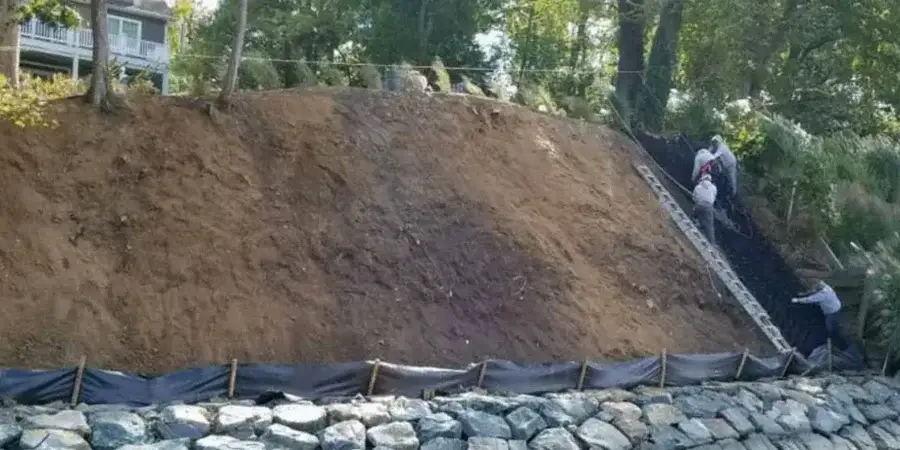
Illustrative image of Soil classification (USCS/AASHTO) in Coventry
A misidentified glacial till layer in Coventry can lead to bearing capacity errors exceeding 50%. Systematic USCS and AASHTO classification prevents that.

Our service areas

Process overview

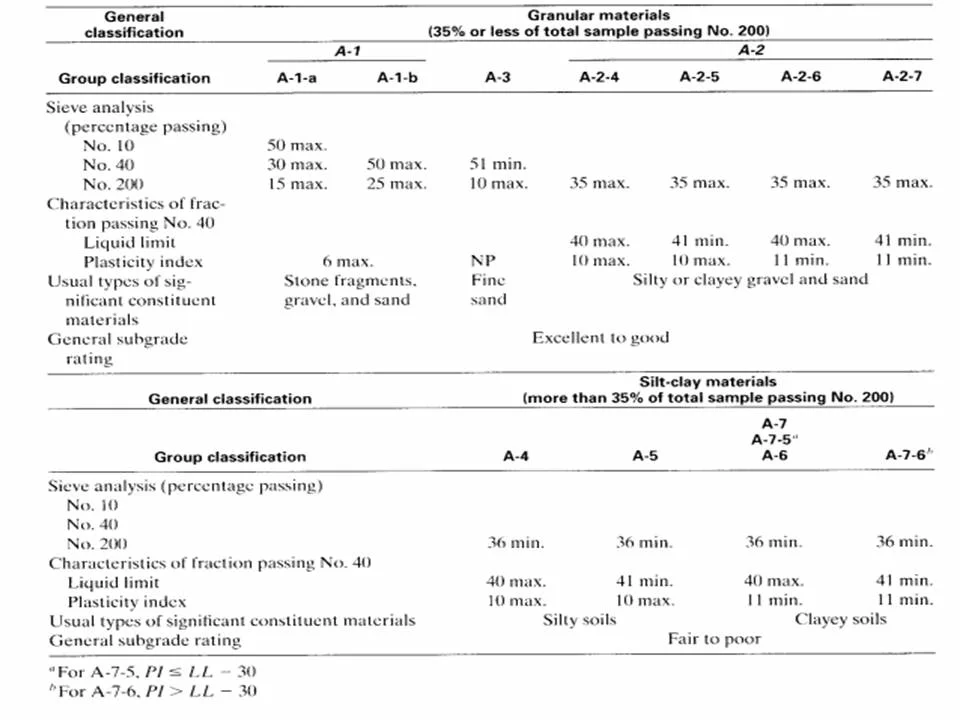
In Coventry, we often see that soils described as 'stiff brown clay' on borehole logs actually contain significant proportions of sand and gravel lenses, especially near the River Sowe corridor. A visual-manual classification alone is insufficient here. The laboratory process begins with a washed sieve analysis to determine the percentage of gravel, sand, silt and clay fractions. For the fine fraction passing the 63-micron sieve, Atterberg limits (liquid limit, plastic limit, plasticity index) are measured following BS 1377-2. The combined data is plotted on the Casagrande plasticity chart to assign the USCS group symbol. When the project also requires AASHTO classification for pavement subgrade assessment, we use the same gradation and plasticity data to compute the group index. This dual-classification approach is particularly useful for Coventry's road schemes, where the AASHTO system helps predict frost susceptibility and drainage behaviour. Complementing this laboratory work with an in-situ CPT test provides a continuous vertical profile that validates the classification layer by layer, while a plate load test gives direct stiffness data for the classified material.
Technical reference — Coventry

Local context

Coventry expanded rapidly during the post-war reconstruction, with many housing estates built directly on made ground and uncontrolled fill without proper soil classification. The legacy of that period is visible today: differential settlement in semi-detached homes, cracked pavements, and persistent drainage problems in areas like Wyken and Stoke Aldermoor. When the fill material is a mix of demolition rubble, clay and organic debris, its engineering behaviour is unpredictable unless it is first classified correctly through sieve and plasticity tests. A fill layer misclassified as 'clay' when it actually behaves as a coarse-grained material can lead to inappropriate foundation design. The risk is compounded by Coventry's moderate seismic activity — the 2002 Dudley earthquake (magnitude 5.0) caused minor ground deformation in the city — where unclassified fills may amplify ground motion unpredictably.

Need a geotechnical assessment?

Reply within 24h.

Email: contact@geotechnical-engineering.biz

Reference standards


BS 5930:2015 — Code of practice for ground investigations (soil description and classification), BS 1377-2:1990 — Methods of test for soils (Atterberg limits and plasticity indices), AASHTO M 145-91 (2021) — Classification of soils for highway subgrades, BS EN ISO 14688-2 — Standard practice for classification of soils for engineering purposes (USCS)

Technical parameters

ParameterTypical value
USCS Group Symbole.g. CH, CL, ML, SM, GC
AASHTO Group Index0 to 20+ (higher = poorer subgrade)
Liquid Limit (LL)Measured per BS 1377-2, ±1% precision
Plasticity Index (PI)Derived from LL and PL, key for USCS chart
Percentage passing 63 µmWashed sieve; determines fine fraction dominance
Natural Moisture ContentOven-dry method, reported to 0.1%

Top questions


How are soil samples collected for classification in Coventry?

Samples are collected using a combination of hand augers for shallow depths (up to 1.5 m) and tracked percussion rigs for deeper profiles. Undisturbed samples are taken in 100 mm diameter thin-walled tubes to preserve structure and moisture content. All sampling follows BS 5930:2015 procedures.

What is the difference between USCS and AASHTO soil classification?

USCS (Unified Soil Classification System) groups soils by grain size and plasticity for general geotechnical use. AASHTO classifies soils primarily for highway subgrade performance, using a group index that quantifies the material's expected load-bearing capacity and frost susceptibility. Both systems are used in Coventry for different project types.

How long does a full soil classification take in your lab?

A standard classification including sieve analysis and Atterberg limits is completed within 5 to 7 working days from sample receipt. Rush orders can be processed in 3 working days at an additional charge. The final report includes USCS group symbol, AASHTO group index, and a plasticity chart.

What is the typical cost for soil classification testing in Coventry?

The cost for a single sample classification ranges from £40 to £70, depending on the number of tests required (visual, sieve, Atterberg, dual USCS/AASHTO). Volume discounts apply for projects with more than 10 samples. Contact us for a detailed quote based on your specific testing scope.

Visual overview

Location and service area

We serve projects across Coventry.

Location and service area